
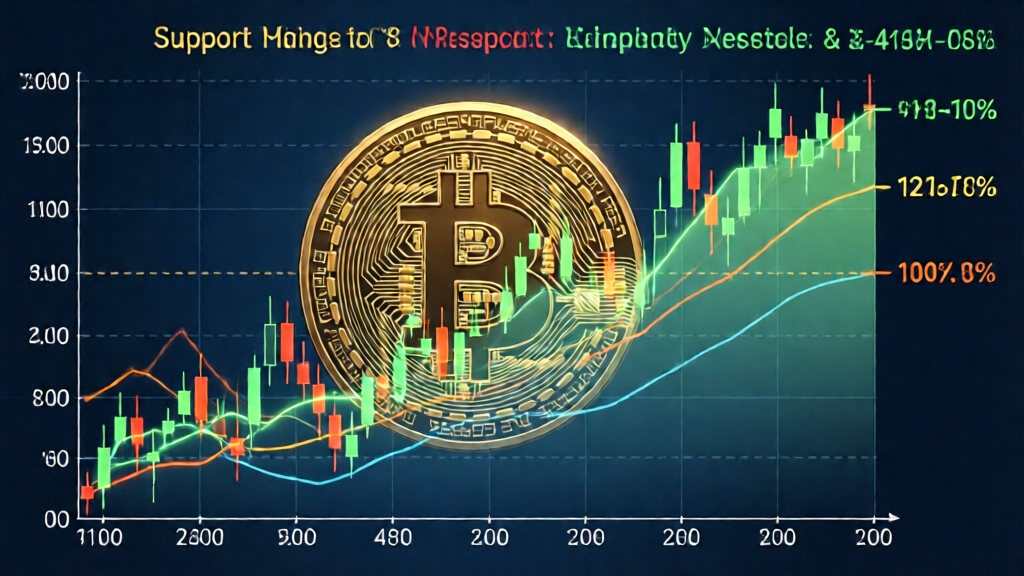

Understanding Bitcoin Support and Resistance Levels
In the volatile world of cryptocurrencies, Bitcoin remains the center of attention. It often raises the question: How do we predict its price movements? One methodology that traders and investors use is analyzing support and resistance levels.
Data shows that as of 2025, Bitcoin has exhibited particular trading patterns that revolve closely around these two vital concepts. Understanding them can improve your trading decisions significantly.
What Are Support and Resistance Levels?
Support and resistance levels are critical price points on a trading chart, where the price tends to halt or reverse its direction.
- Support Level: This is a price point at which a downtrend can be expected to pause due to a concentration of buying interest. Think of it as the floor price.
- Resistance Level: Conversely, this level is where a price increase can be expected to pause due to selling interest. You can visualize it as the ceiling price.
Both levels are vital for offering insights into potential price trends, and understanding them is fundamental for effective trading strategies.
Why Are Support and Resistance Important for Bitcoin Traders?
Understanding Bitcoin support resistance is essential for various reasons:
- Enable traders to identify entry and exit points for their trades.
- Help in setting stop-loss and take-profit orders effectively.
- Provide insights into market psychology and supply-demand mechanics.
As traders analyze these levels, they can also observe other market dynamics, leading to more informed decisions.
How to Identify Bitcoin Support and Resistance Levels
Identifying these levels can be done using various techniques:
- Historical Price Levels: Look for past price data to determine where prices have bounced off multiple times. For instance, if Bitcoin bounced back several times at the $40,000 mark, it can be established as a strong support level.
- Moving Averages: Utilizing moving averages like the 50-day or the 200-day can provide insight into potential support or resistance.
- Trend Lines: Drawing lines on a chart that connect lower lows or higher highs can visualize support and resistance.
When traders combine these methods, they can develop a more comprehensive understanding of price movements.
Analyzing Bitcoin Current Data for Support and Resistance
With the rapid changes in the cryptocurrency market, staying updated is crucial. Let’s analyze some current data.
| Date | Price | Support Level | Resistance Level |
|---|---|---|---|
| March 1, 2025 | $50,000 | $48,000 | $52,000 |
| March 5, 2025 | $51,500 | $49,500 | $53,500 |
Sources: CoinMarketCap for data verification
This data indicates that the support level seems to be solid around $48,000 and resistance around $52,000, illustrating a potential trading range.
Practical Tips for Utilizing Support and Resistance in Trading
Here are some hands-on tips:
- Use multiple time frames: Assess both short-term and long-term support and resistance levels to refine trading decisions.
- Watch for breakouts: If Bitcoin’s price breaks through a resistance level, it often signals a new upward trend.
- Consider volume: High trading volumes around these levels can validate the strength of support or resistance.
The essence lies in continuous evaluation and adapting strategies based on evolving data.
Conclusion
In the world of cryptocurrency trading, understanding Bitcoin support and resistance levels is indispensable. With proper knowledge, traders can leverage these concepts to make informed decisions.
With Bitcoin’s frequent price fluctuations, pinpointing these points will help you navigate its complexities. Do consider utilizing reliable platforms such as btcmajor for expert insights and market analysis.
Written by Financial Analyst John Smith, he has authored over 30 papers in the cryptocurrency domain and led audits for several prominent blockchain projects.