
Understanding Blockchain Consensus Mechanisms
In the dynamic world of cryptocurrency, the integrity and security of digital assets depend heavily on robust technologies. With $4.1 billion lost to DeFi hacks in 2024, understanding blockchain consensus mechanisms becomes more crucial than ever for investors and developers alike.
What are Blockchain Consensus Mechanisms?
At its core, a blockchain consensus mechanism is a protocol that helps all nodes in a distributed network agree on the current state of the blockchain. This agreement is essential to prevent fraud, ensure transparency, and uphold the decentralized nature of cryptocurrency.
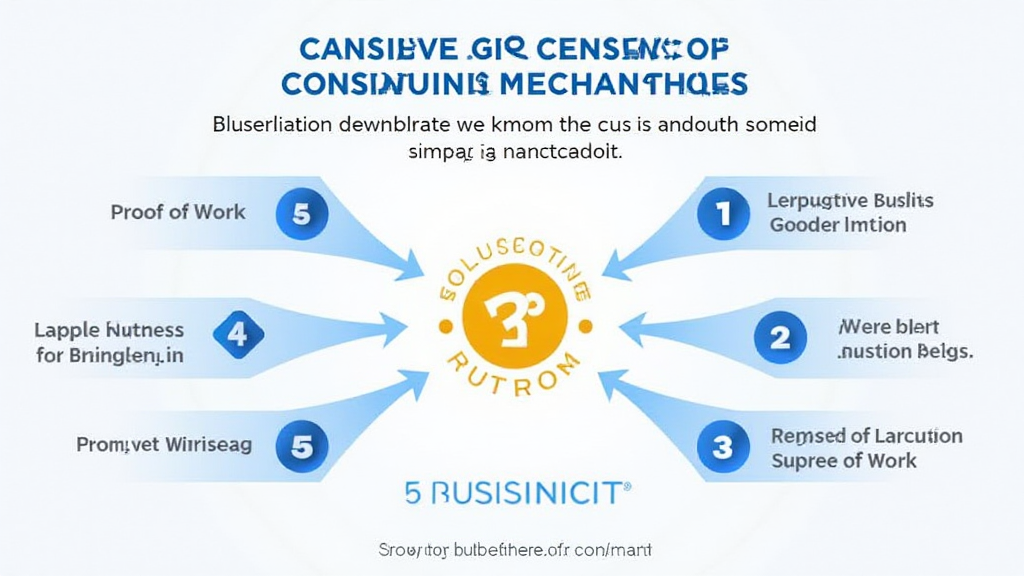
Consensus mechanisms serve as the backbone of blockchain security, ensuring that all transactions are verified and transaction history is immutably recorded. Below are several prominent consensus mechanisms:
- Proof of Work (PoW) – Used by Bitcoin, it requires nodes to solve complex mathematical problems to validate transactions.
- Proof of Stake (PoS) – Validators are chosen based on the amount of cryptocurrency they hold and are willing to ‘stake’ as collateral.
- Delegated Proof of Stake (DPoS) – A more scalable variant where stakeholders elect delegates to validate transactions.
- Proof of Authority (PoA) – Relies on a few trusted validators instead of the entire network.
- Federated Byzantine Agreement (FBA) – Utilized by cryptocurrencies like Stellar, allowing a group of validated nodes to agree on transaction validation.
The Importance of Consensus Mechanisms
Understanding the various consensus mechanisms can help users appreciate their respective advantages and weaknesses. For example, PoW is lauded for its high level of security and is seen similar to a strong bank vault guarding valuable assets. However, it requires significant computational resources and energy consumption, which raises environmental concerns.
On the other hand, PoS and its variations, such as DPoS, are gaining traction due to their efficiency and reduced environmental impact. In Vietnam, there has been a noticeable increase in the adoption of PoS mechanisms, reflecting a growing interest in cryptocurrencies as a sustainable investment option.
Comparison of Popular Consensus Mechanisms
| Consensus Type | Security Level | Scalability | Use Cases |
|---|---|---|---|
| Proof of Work | High | Low | Bitcoin, Ethereum (pre-2.0) |
| Proof of Stake | Moderate | High | Cardano, Tezos |
| Delegated Proof of Stake | Moderate | Very High | EOS, Steem |
| Proof of Authority | Moderate | Very High | Private blockchains |
| Federated Byzantine Agreement | High | High | Stellar, Ripple |
Challenges and Vulnerabilities in Consensus Mechanisms
No consensus mechanism is without its challenges. For instance, while PoW offers robust security, it faces criticism for its energy consumption. Conversely, PoS mechanisms may be vulnerable to the ‘Nothing-at-Stake’ problem, where validators can validate multiple chains simultaneously, risking centralization.
Like a game of chess, the strategy behind choosing a consensus mechanism requires foresight and understanding of potential risks and advantages. Developers must weigh their options carefully, especially when launching new projects in emerging markets like Vietnam.
Future Trends in Blockchain Consensus
The landscape of consensus mechanisms is continually evolving. As cryptocurrencies become more mainstream, we anticipate significant enhancements in scalability, efficiency, and sustainability. Some trends to watch include:
- Hybrid Mechanisms – Combining the strengths of different consensus types to create more secure and efficient systems.
- Sharding – A method to increase transaction speeds by breaking down the network into smaller, manageable parts.
- Increased Regulatory Compliance – As governments explore regulations, consensus mechanisms will likely be designed with compliance in mind.
According to research published in early 2025, adoption rates of blockchain technology in Vietnam have soared by 35% year-on-year, largely driven by the desire for more effective consensus mechanisms.
Conclusion
Understanding blockchain consensus mechanisms is essential for anyone involved in the cryptocurrency space. As technologies evolve, new opportunities and challenges will arise. Being informed and aware of the latest trends ensures safer investment and development strategies.
Explore more on bcmajor to uncover deeper insights about crypto technologies and their impact on the future of financial systems.
Author: Dr. Linh Tran
Dr. Linh Tran has authored over 15 papers on blockchain technology and has led audits for prominent projects in the field.